


Home
>
Old West Iron Blog: Craftsmanship, Heritage & Hand-Forged Expertise
>
The Origins of the Forge: Blacksmithing in the Ancient World

The Origins of the Forge: Blacksmithing in the Ancient World
di Maddison Mellem il Sep 09, 2025Before the skyscraper, before the chisel, before even the wheel—there was fire and metal. The story of blacksmithing begins not in a workshop or a guild, but in the heart of ancient civilizations where the first sparks of metallurgy forever changed the path of human history.
Long before the American West was shaped by the clang of iron on iron, blacksmiths were at work in the river valleys of Mesopotamia, along the banks of the Nile, and deep within the dynasties of ancient China—building tools, weapons, and traditions that would carry across time.

Early Metalworking in Mesopotamia, Egypt, and China
The earliest evidence of blacksmithing as a practiced craft dates back more than 6,000 years, to the cradle of civilization in Mesopotamia. Here, ancient metallurgists learned to extract copper from ore, hammer it into tools, and form early agricultural equipment that would shape the rise of cities.
In Egypt, metalworkers gained notoriety as temple artisans and royal smiths. Using copper and later bronze, they crafted chisels, swords, and ceremonial jewelry, often working in open-air forges with stone hammers, bellows made from animal skins, and primitive anvils made of rock or cast stone.
In ancient China, blacksmiths elevated metalwork to high art. By the Shang dynasty (~1600 BCE), Chinese forges were producing bronze vessels, arrowheads, and farming tools using advanced casting and mold techniques that set them apart. The earliest Chinese blacksmiths were integral to both war and peace, producing everything from plowshares to spear tips.

The Tools of the Ancient Trade
Though far removed from modern forges, ancient blacksmiths relied on an intuitive understanding of heat, timing, and raw force. Their toolkits, while rudimentary by today’s standards, laid the foundation for all smithing to come.
-
Stone Hammers: Used before the invention of iron tools, these were often smooth river stones or crudely shaped mallets, used for shaping hot metal.
-
Primitive Anvils: Simple blocks of stone or bronze served as the first anvils. Their flat surfaces allowed early smiths to flatten, bend, and refine metal.
-
Clay Furnaces: Small, bowl-shaped furnaces were fueled by charcoal and stoked by hand-powered bellows. Temperatures had to be carefully maintained for smelting copper or bronze.
-
Tongs and Crucibles: Even in the earliest days, blacksmiths needed tools to handle molten metal and to pour it into stone molds.
Despite the lack of modern precision, these tools made it possible for early smiths to craft strong, functional, and sometimes beautiful pieces—bridging the gap between survival and culture.
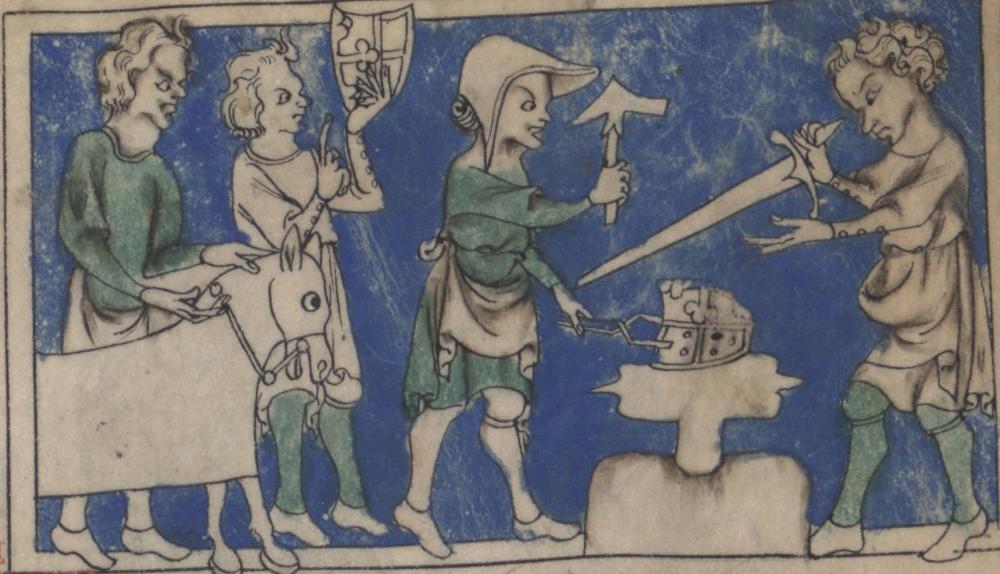
Copper, Bronze, and the Dawn of the Iron Age
At the start, blacksmiths worked almost exclusively with copper—a relatively soft metal that was easy to extract and shape. But copper had limitations. It dulled quickly, bent under stress, and lacked the strength for serious warfare or architecture.
Enter the Bronze Age.
Around 3000 BCE, blacksmiths in Mesopotamia and Egypt began alloying copper with tin to form bronze, a harder, more durable metal. This allowed for sharper weapons, stronger tools, and a creative leap in metal artistry. The Bronze Age ushered in major advances in both technology and trade, as cultures sought the materials to produce better bronze.
But the real revolution came with iron.
Around 1200 BCE, ancient blacksmiths began experimenting with iron ore, learning to extract and forge it under immense heat. The process was difficult—it required higher temperatures and greater skill—but the result was transformative. Stronger, sharper, and far more abundant than tin or copper, iron quickly became the metal of empires.
Thus began the Iron Age, when blacksmiths became indispensable builders of civilization—shaping everything from swords and spears to hinges, nails, and horseshoes.

The Legacy Lives On
The ancient forge may seem a world away from today’s hardware and hand-forged brackets, but at its core, the craft remains unchanged. Fire, pressure, precision, and patience—these elements still guide the modern blacksmith.
At Old West Iron, we carry on that legacy by crafting hand-forged hardware the old-fashioned way, using both modern tools and time-honored techniques. From our veteran-run forge in Idaho to the customers restoring barns and homesteads across the country, we are proof that the ancient art of blacksmithing still holds its place in the modern world.
Explore Hardware Forged With History »
Maddison Mellem
Writing from the forge at Old West Iron